
The Allure of Letterpress Printing
printing terminology | beautiful invitations
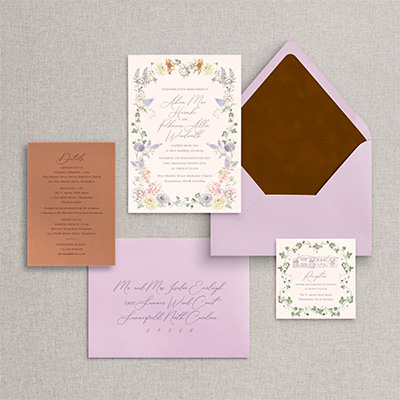
Letterpress is absolutely stunning, which is why it is one of our favourite styles to create as artists and stationers. You have probably heard the term “letterpress” more than once, but what exactly is it that makes this form of printing so uniquely beautiful? It is a classic form of printing that has been modernised, but its true nature of beauty and authenticity remains unchanged.
The letterpress printing technique has evolved over the years. Historically, the printing press – the first method of mass producing anything printed – used letters, carved entire pages of text, or engravings to create the image. The ink merely ‘kissed’ the page and didn’t make an impression. However, today, people seek to have the “pressed” be literal and want the ink really pressed into the page to create the effect of dimension. Polymer dies have replaced boxes of letters to create an image. Now we can print almost any artwork that can be created!
Letterpress
The art of letterpress printing is one of the original printing techniques and is still used today because of the beautiful results that it can produce on cards and invitations. We use this to give your prints dimension that flat printing can’t achieve, and the result is absolutely spectacular! Printing has changed quite a lot over the years, making it difficult to receive the same results through modern technology, which is why us paper nerds love this reimagined historic technique.
If you are exploring different printing methods for your wedding stationery, our invitation ordering guide explains the differences between letterpress, foil, blind embossing, and blind debossing.
How does letterpress work?
When letterpressing, an inked roller coats the elevated portion of the design on a polymer die and then presses it into the paper. The raised portion applies the ink as well as indents the surface of the paper, giving your paper dimensionality. We use soft papers that are “fluffy” so that the fibres can be condensed and the impression is accentuated.
This technique is similar to blind debossing. The difference is that “blind” refers to the lack of ink. The design is pressed into the paper fibres, leaving the paper showing through. While polymer plates are used for letterpressing on our original Heidelberg machine, debossing plates can be metal or polymer.
For more information about the different printing techniques available, you can also explore our frequently asked printing questions.
Why choose letterpress?
Letterpress is one of our favourites around here. It is classic and timeless. Combined with a cotton paper, it feels and looks very luxurious. Whether you have a special wedding day coming up or you just want to jazz up those business cards, letterpress is definitely a way to make a statement if you want to leave a lasting impression – pun intended!
Letterpress can be particularly effective when used on wedding invitations, where the combination of pressed ink, textured paper, and dimensional detail can become part of the overall stationery design.
Frequently asked questions
-
What is letterpress printing?
Letterpress is a traditional printing technique that uses an inked raised design to press ink into paper. The process creates both printed colour and a dimensional impression in the paper.
-
How does letterpress differ from digital printing?
Digital printing lays the image flat on the paper, while letterpress presses the inked design into the paper to create a tactile impression. Marsupial Papers’ printing FAQ describes digital printing as using toner that lays flat, while letterpress uses a polymer die and presses into the page.
-
What type of paper works well for letterpress?
Soft papers with enough fibre to accept the impression can help accentuate the dimensional effect of letterpress. Cotton paper is also commonly associated with the luxurious look and feel of letterpress stationery.
-
What is the difference between letterpress and blind debossing?
Letterpress uses ink and presses the design into the paper. Blind debossing creates an impression without ink. In blind debossing, the paper is pushed down into the page while the paper itself provides the visible effect.
-
Can letterpress be used for wedding invitations?
Yes. Letterpress is suitable for wedding invitations and other stationery where a tactile, dimensional finish is desired. It can be used to create a classic look with pressed ink and textured paper.
-
Can letterpress be combined with other printing methods?
Marsupial Papers states that it can combine different print processes, although there are specific restrictions around combining thermography with letterpress, foil, blind embossing, or blind debossing. The printing method and order of production can affect the final finish.
If you are considering letterpress for your next stationery project, explore our wedding invitation collection or review our printing FAQs to learn more about the available printing options.